
The comfort trap is dangerous because it does not look like failure in the beginning. It looks like peace, security, routine, and control. But over time, it can reduce ambition, learning, adaptability, and professional relevance. In a world where skills, technology, industries, and workplace expectations are changing quickly, professionals cannot afford to remain still.
The goal is not to reject stability. The goal is to stay stable without becoming stagnant. A successful professional is one who values security but continues to learn, improve, adapt, and contribute. Growth begins when we are willing to step beyond comfort and prepare ourselves for the future.

1. Understanding the Comfort Trap
Stability is valuable, but it becomes dangerous when it removes the desire to improve. The comfort trap begins when a professional feels safe in routine, avoids challenge, and slowly stops learning. It does not look like failure at first; it looks like peace, routine, control, and predictability. Over time, however, the person may become less ambitious, less adaptable, and less relevant in a changing workplace.
2. How Comfort Zones Replace Growth Zones
Comfort zones enter professional life quietly. A person continues doing daily work, but the hunger to learn, experiment, and accept difficult assignments begins to reduce. The result is activity without meaningful growth.
- Familiar tasks become preferred over challenging assignments.
- Fear of failure or criticism makes the person avoid new responsibilities.
- Past experience starts replacing new learning and market awareness.
- The person may remain busy but stop becoming better.
3. Why Stability Can Reduce Ambition, Learning, and Adaptability
Stability gives confidence and financial security, but it can also reduce urgency. When a person believes that a secure job, regular salary, or fixed position is enough, ambition becomes weak and learning becomes optional. This is risky because professional success now depends on continuous improvement, adaptability, and visible value creation.
- Ambition reduces when there is no pressure to compete or improve.
- Learning slows when current skills seem “good enough.”
- Adaptability declines when a person spends too long in one system or role.
- Confidence becomes limited to familiar situations only.
4. Hidden Risks of Long-Term Routine in Fast-Changing Industries
Routine becomes especially risky when industries are changing quickly. Technology, automation, artificial intelligence, digital platforms, data analytics, and global competition are reshaping many jobs. A person may not notice the danger until a role becomes outdated or a new system exposes skill gaps.
- Routine work is easier to automate, outsource, or replace.
- Employees who do not update skills may lose relevance despite experience.
- Younger or more skilled professionals may move ahead faster.
- Sudden organizational change can create stress for people who avoided learning earlier.
5. How Organizations Unintentionally Reinforce Stagnation
Stagnation is not only an individual problem; organizations can also reinforce it. When workplaces reward only routine compliance, attendance, and task completion, employees may stop taking initiative. If training, mentoring, job rotation, and innovation are weak, people remain busy but do not grow.
- Performance systems may reward obedience more than improvement.
- Managers may avoid rotation because it creates temporary disruption.
- Seniority-based promotions can reduce the pressure to build capability.
- Limited feedback and coaching keep employees unaware of their growth gaps.
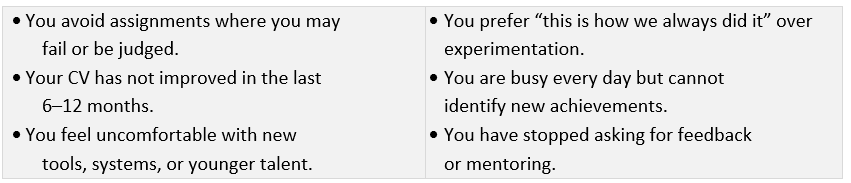
6. Warning Signs: Are You in the Comfort Trap?
7. Practical Ways to Stay Stable Without Becoming Stagnant
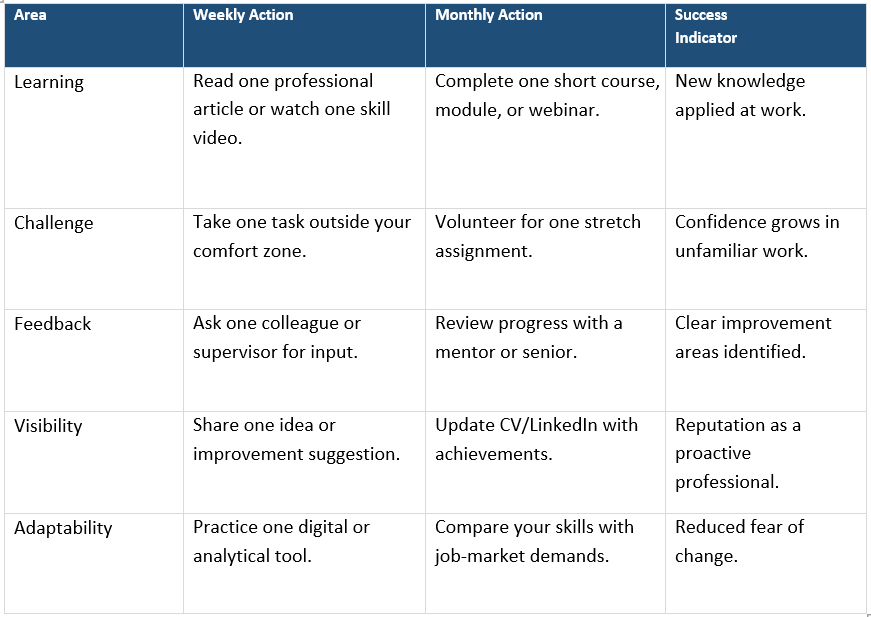
The answer is not to reject stability; the answer is to combine stability with growth. A strong professional protects their current position while continuously developing skills, visibility, confidence, and future readiness.
8. 30-Day Personal Growth Challenge
- Week 1: Identify your comfort-zone habits and choose one skill to improve.
- Week 2: Take one difficult task, seek feedback, and note what you learned.
- Week 3: Learn a new tool, method, or concept relevant to your profession.
- Week 4: Present one improvement idea, update your growth plan, and set next month’s target.
9. Reflection Questions for Discussion
- Where in my professional life am I choosing comfort over growth?
- What skill will make me more valuable in the next three years?
- What routine should I improve, redesign, or replace?
- Who can guide, mentor, or challenge me to become better?
10. Long-Term Success Formula
- Stability + Learning = Sustainable Growth
- Experience + Adaptability = Professional Relevance
- Routine + Improvement = Better Performance
- Comfort + Challenge = Balanced Success
- Security + Ambition = Future Readiness
Key Message: Stability is useful when it supports growth. It becomes harmful when it replaces ambition, learning, and adaptability.
Sources for statistics: World Economic Forum Future of Jobs Report 2025; Gallup State of the Global Workplace 2026; LinkedIn Workplace Learning Report 2025.
Recent Comments